Add/Remove multiple users to WEBCON group
The action adds or removes multiple WEBCON users to/from a single WEBCON group. It can be placed on any automation event — e.g. on entering a step, on leaving it, on a path, or on a menu button.
Basic configuration
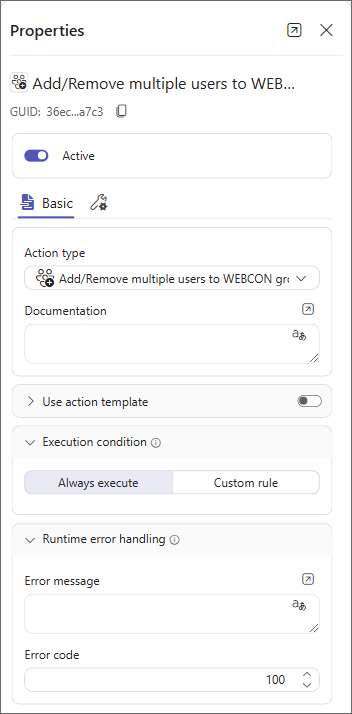
The Basic tab of the Properties panel contains settings shared by every action in an automation: the Active toggle, the Action type field, the Documentation field, the Use action template toggle (when enabled, the action takes its configuration from the selected action template defined in the process), the Execution condition section (decides whether the action always runs or only when a custom rule is met), and the Runtime error handling section (the message and numeric error code returned when the action fails). Since these settings are not unique to the Add/Remove multiple users to WEBCON group action, they are described in detail in the Actions chapter.
Advanced configuration
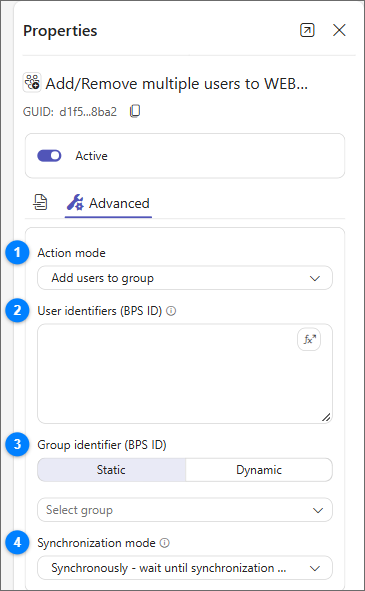
The Advanced tab contains fields specific to this action. Choosing the mode (adding or removing) does not change the visibility of any other field.
1. Action mode
The Action mode field determines whether running the action adds users to the selected group (the Add users to group option) or removes users from the selected group (the Remove users from group option).
2. User identifiers (BPS ID)
The User identifiers (BPS ID) field indicates the identifiers of the users being added or removed. An identifier can be provided in two ways:
- in UPN format (e.g.
t.smith@webcon.com), - as an Active Directory group identifier (e.g.
WEBCON\S-1-5-32-544) — this lets you add (or remove) an entire AD group as members of the selected WEBCON group, not just individual users.
For multiple users, separate the individual identifiers with a semicolon (e.g. t.smith@webcon.com;a.brown@webcon.com). The field value can be filled in dynamically by pointing it to a business rule (the fx button).
3. Group identifier (BPS ID)
The Group identifier (BPS ID) field indicates the single WEBCON group the users are to be added to or removed from. The field can be filled in two ways:
- Static — the group is selected from a searchable list of existing WEBCON groups in the Select group field.
- Dynamic — the Group selection expression field accepts a group identifier in UPN format (e.g.
management@webcon.com), provided as a static value or a business rule (the fx button).
4. Synchronization mode
After users are added to or removed from a group, an independent synchronization operation must be performed. Synchronization can take a few seconds — until it finishes, the change is not available in the system. The Synchronization mode field offers three options:
- Synchronously - wait until synchronization finished — the action only finishes once synchronization completes. Use this mode when subsequent actions in the sequence rely on the change. In this mode, the change is saved outside the transaction in which the sequence of actions runs — if a later action in the sequence returns an error, rolling back the transaction will not roll back the change that has already been made.
- Asynchronously - do not wait until synchronization finished — the action starts synchronization but does not wait for it to finish; synchronization runs as the last operation after the transaction completes successfully. If a later action in the sequence returns an error, the change is also not applied to the system.
- No synchronization - changes will be visible after the next user synchronization — the action does not start synchronization. The change becomes visible after the scheduled user synchronization runs or after the Synchronize users list action is executed. This mode is recommended when many changes are made one after another, followed by a single synchronization.