Exchange calendar
The action adds, updates, or deletes an appointment in a user's calendar on an Exchange server.
Basic configuration
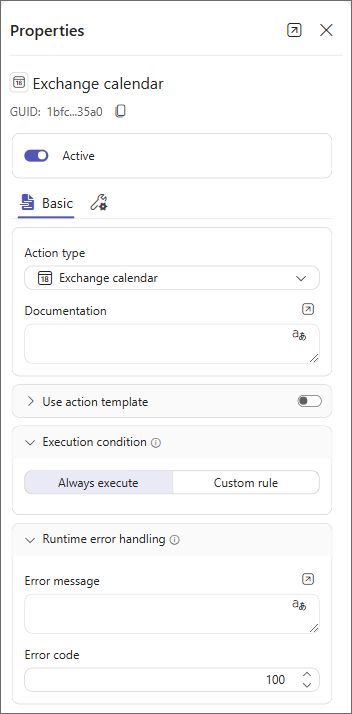
The Basic tab of the Properties panel contains settings shared by every action in an automation: the Active toggle, the Action type field, the Documentation field, the Use action template toggle (when enabled, the action takes its configuration from the selected action template defined in the process), the Execution condition section (decides whether the action always runs or only when a custom rule is met), and the Runtime error handling section (the message and numeric error code returned when the action fails to execute). Since these settings are not unique to the Exchange calendar action, they are described in detail in the Actions chapter.
Advanced configuration
The Advanced tab contains fields specific to this action, grouped into sections: general fields, Meeting details, Author, Required participants, and Optional participants. In the screenshot below, the Required participants and Optional participants sections are collapsed as they have exactly the same field structure as the Author section.

1. Data connection
The Exchange Server data source the action is directed to.
2. Trigger
The action's behavior once triggered:
- Write - adds a new appointment to the calendar.
- Modify - changes an existing appointment.
- Delete - removes the appointment from the calendar.
The option selected here affects the availability of other fields of the tab.
3. Form field storing Exchange task ID
The form field the Exchange task identifier is written to (when adding an appointment) or read from (when updating or deleting an appointment).
4. Meeting details
The section holds the detailed parameters of the appointment itself:
-
Subject, Content, and Location — basic information about the appointment; each field can be built dynamically using the rule editor available under the fx icon.
-
Categories — the categories assigned to the appointment.
tipSeparate individual categories with semicolons, e.g.
Category1;Category2. -
Date from and Date to — the appointment's start and end date/time.
tipFormat dates as
yyyy-MM-dd HH:mm:ss, or reference a form field value, e.g.field({123}). -
Status — the user's availability during the appointment.
-
Priority — the appointment's priority: low, normal or high.
-
All-day event — determines whether the appointment is marked as an all-day event.
-
Reminder — enabling this option reveals an additional field specifying how many minutes before the appointment a reminder should be shown.
5. Author
The section lets you specify the organizer of the appointment. Only one user can be the organizer — if the configuration resolves to more than one, the first one on the list is used.
Configuration mode determines how the organizer is decided:
-
Basic — the organizer is selected from a user list or based on a form field value. The following fields are then available:
- System users — a User list / Value from form field toggle: either a static pick of a user or group (with an Active Directory search), or a dynamic pick based on a form field value.
- User email addresses (defined by expression) — the participants' email addresses, built dynamically using the rule editor.
- Predefined users — an additional source of participants. You can select the author, people assigned a task or a CC task on the workflow instance, or all assigned people.
-
Advanced (SQL) — the organizer is determined by the Query (SQL or CAML) field — a query returning the organizer's login or email address. The additional Data source field lets you specify which database the query is directed to; by default, the query runs against the database Designer Studio is currently running on.
6. Required participants
The section has exactly the same field structure as the Author section (Configuration mode: Basic or Advanced) and specifies participants whose presence at the appointment is required.
7. Optional participants
The section has exactly the same field structure as the Author section and specifies participants whose presence at the appointment is optional.